Sunday, May 30, 2010

Boston, Maine, Audrey-Boo, and Television

I'm starting it off with some family pictures: Gail my college roommate with her husband Jim and their daughters, Audrey, who can be coquettish and charming, and Amelia, the little explorer.  Skepticism towards strangers is a quality I admire in young children, and I enjoyed the process of their warming up to me by the time I had to leave.  A family diptych:


I stopped to visit Gail and family both weekends en route to and from a personal and professional development retreat in very southern Maine.  Here we are:
And here's the whole family including Gail's parents:
Everyone remembers the story of the first time Gail and I spoke on the phone, her slight trepidation at being a Bostonian with a roommate from Alabama, only confirmed by my making the standard joke, "I like both kinds of music, Country and Western."  She said later she was much relieved when in the same conversation I mentioned having an L.L. Bean rug and wondering if we had space for it in our room.

Speaking of freshman year, I went to lecture in the class of my art school friend Matt Templeton at Suffolk, the New England College of Art and Design.  It was near the end of term and I think everyone was exhausted, but it was fun to do "Business School for Artists" in the context of a class that is essentially designed to help freshmen decide if they want to study the fine or applied arts (i.e., painting or graphic design).

Matt videotaped the class, and when I learn to retrieve video stills, perhaps I will have more varied documentation.  After class, I legged it to the Boston Museum of Fine Arts, on strong recommendation from Gail's garden-loving mom, to see a three-day annual show called "Art in Bloom."  Local gardening and flower groups or shops interpret various works of art in bouquet form.  Here are some examples, the Botero (the next to last) a favorite:


While at the MFA, I went down memory lane and visited the gallery where the Museum Legs chapter First Friday is set.  With regard to royal children scurrying around with royal dwarfs, in proximity to Mannerist depictions of the dying Christ, exhibits 1 and 2:

This is the larger room, though you can't get the feel without Billy Ocean and the teeming, dancing groups of (Karen's phrase) "divorcees in bad shoes."

That Tuesday, Mo, a new, New York friend, picked me up to drive to York Harbor, Maine, for the workshop, a place you can, among other things, turn aspects of your life into Jungian symbols, to great effect:

It was a beautiful setting, where we were treated to a near complete spectrum of New England weather -- shown here, the breezy, bright sun, rather than the hail forecast:
Our fearless leaders from Dialogos:
And, an approximation of our lovely group of women attendees:
This was part of a very panoramic-formatted photograph in the inn's hallway.  I would include lovely pictures I have of the actual participants, and I doubt people would mind, but on principle, I'll not.  Here's the lighthouse view near where we went to the lobster pound the last night:
Returning to "civilization" where Jungian symbols are also actors and much of life is in the fray, I accompanied Gail, Jim, and the girls to a Kentucky Derby party where I was summarily robbed of the coveted last place finish prize.  My horse came in next to last.  (I find it is part of good manners of being a tag-a-long to a betting party to perform very poorly, or so has been my entirely accidental strategy at two different Oscars parties.) How fantastic is this horse:
It doubles as a flashlight:
Whoever wins it, wherever they are in the world, they get it back to the hosts in time for the next year's party, with the urgency of businesses filing year end paperwork with tax consequences.

The girls are not allowed much television, and they were absolutely delighted with the colors and fanfare of the horses.  Amelia spent the race up on her knees, hands above her head, mostly clapping.  Audrey has slightly more television experience.  (Gail said someone asked Audrey once what she likes on tv and she said, "I like to watch Mickey Mouse.  And people talking."  Gail explained that "people talking" was her impression of all adult programming across all genres.)
The next day we ventured out through Harvard Yard (here in front of the statue of John Harvard that Audrey likes without ever feeling a sentimental or superstitious need to rub his foot for luck):
Still life of sleeping baby in the double-wide:

Audrey with her uncanny, oddly photogenic doll, Audrey Boo, whose hair, Audrey will tell you, is "white, like the doctor and the tailor."
We ventured over the a street fair and got there toward the tail end.  The keeper of the bouncy castle agreed to let Audrey go in, even on the late side, but Audrey is cautious by nature and by the time she worked up her courage, it was closing time.  So, we sat in these folding chairs, were given free popcorn in end-of-the-day generosity, and watched the bouncy castle be deflated.  This is an oddly compelling thing to do, and part of access to that childhood feeling of rightness and simplicity in the world:

Audrey was inspired by nearby music and started dancing.  Not pictured, I taught her a dance move: "up to the sky, down to your shoe" -- the John Travolta classic Stayin'Alive, Saturday-Night-Fever, finger-pointing hip waggle.  Later that night at dinner, Audrey started miming and whispering with her coy smile, "up to the sky, down to your shoe."
Audrey Boo in her curious, arrestingly photogenic state.  (Her eyes do not close.)
And with her faithful protector:
That weekend, one of the chief water mains in Boston broke.  Strangely, Cambridge was unaffected because it gets its water separately from a reservoir.  I totally forgot this and so when I went to the train the next morning, it was downright difficult to find a cup of coffee.  Here is a picture of "Starbucks at Rest" across the street from the train station.  They were only selling bottled water and pastries.
I stopped in Providence on the way back, and returned to the city.

Saturday, May 29, 2010

The Alsdorfs, the Cecil-Kirks, and Talk 20

Tom Kirk, my high school friend Grey's husband, kindly invited me to participate in a rather ingenious--though he said wholeheartedly copycat--program called Talk 20.  Periodically, his architecture firm, Bohlin, Cywinski, Jackson, invites eight or ten people to give talks in succession.  Each person gives 20 slides for 20 seconds each (6-7 minutes), so the whole program runs about an hour.  BCJ is known for many things, among them the Apple stores:
On the scheduled day in February, I took an early train to try to avoid a snowstorm, but once I got to Philadelphia the program was postponed for weather.  Grey had just had a second child, and her parents--my hosts in Birmingham on the book tour--were there too, so it turned into a big family visit.


Brigham, the architect who was organizing the program, could not have been nicer or more apologetic.  We rescheduled for the following month, and it all actually happened.


While killing time between the train and the talk, I sat in a coffee shop Brigham had recommended, where I couldn't help but try to recreate the Bar at the Folies Bergere painting:

Now I realize how different the painting actually looks:
25515.jpg

Arriving at the firm, I met up with Tom (pictured below) and Brigham, who showed me all the plans for the new Williams library.
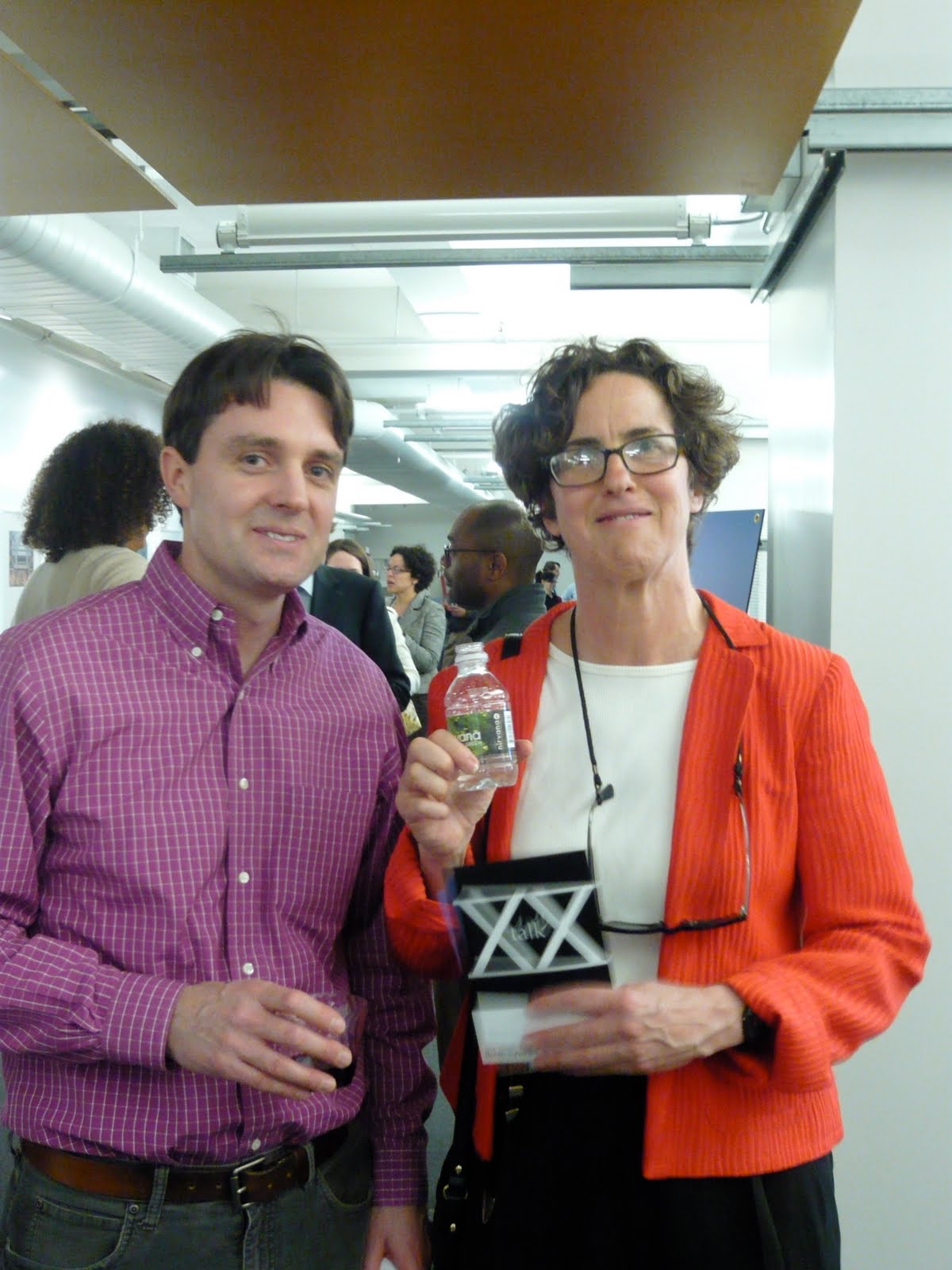
The firm had a happy hour beforehand, at which I met this collaborator of Tom's:
She asked how we knew each other and we both paused -- me because I think in the workplace the person who actually works there should get to tell any personal stories -- and this caused her to tease Tom in an almost British way, seeking innuendo with missile clarity.  Here's a sense of the place, and the party:

(I'm pretty sure I own exactly this chair (a Modernica replica of an Aalto) but in red.)
We spent most of the time talking to my fellow presenter -- also a friend and invitee of Tom -- named Arika Okrent.  She wrote a book called In the Land of Invented Languages (that I am reading now and keep recommending to people).

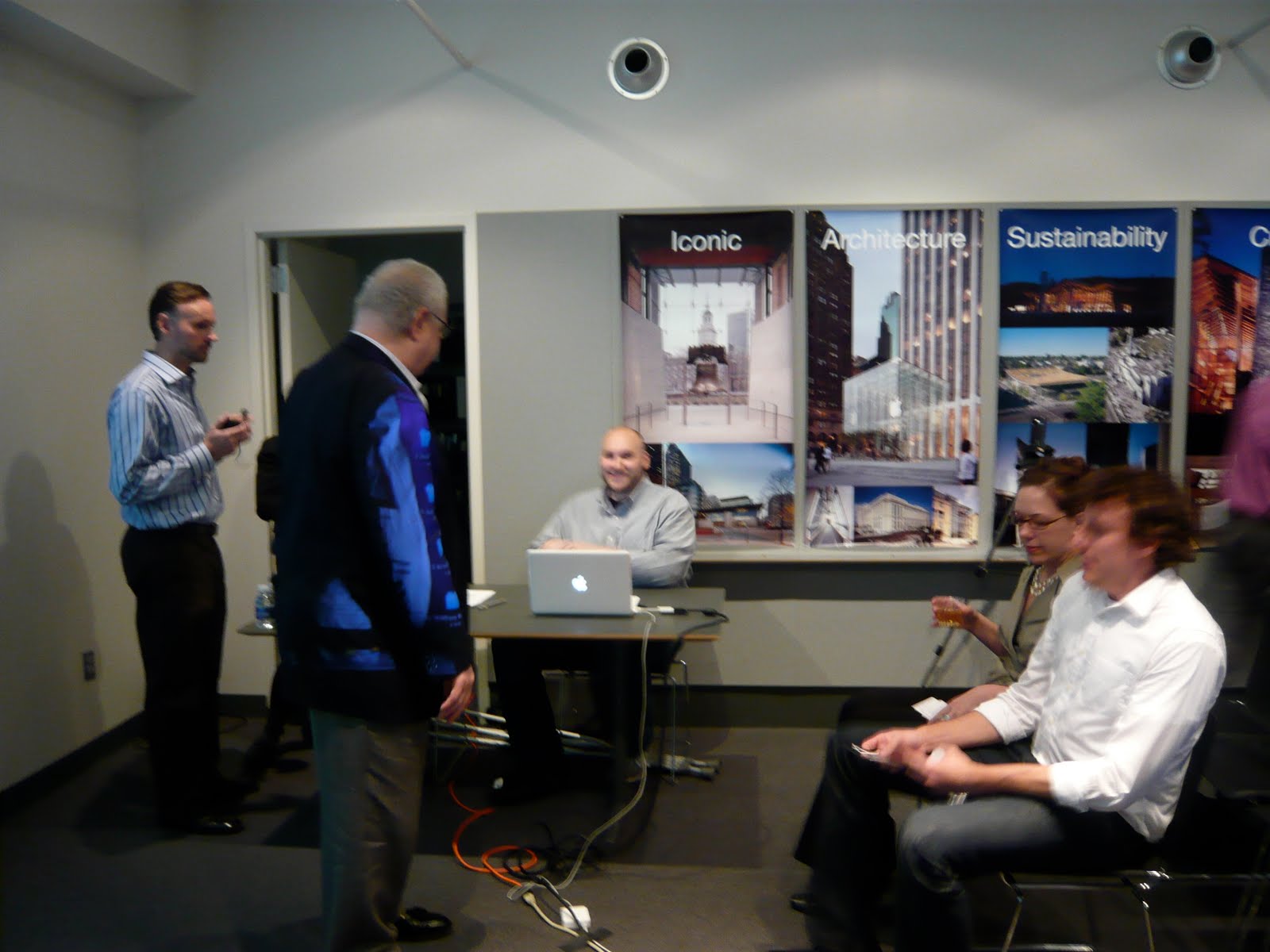
BCJ was founded in Wilkes Barre, Pennsylvania which, by coincidence is also the hometown of my first art history professor from college who knows a couple of the partners.  I seem to thrive on this sort of small world connectedness.  In this picture, Brigham, who also MC'ed, is in the back left corner, with Bernie, the partner who gave an introduction and a synthesis at the end.
Here's how it all began.  They would tee up someone's powerpoint, look to the presenter, who'd call him or herself out of the starting blocks, and we would be off.  The slides were auto-timed to change over every twenty seconds, which can be surprisingly hard to judge precisely.  Most people seemed to have done what I had done, which was to have slides nearly entirely free of text.  Much easier to finesse the transitions of pictures.
As Bernie said to us speakers, "Once you are on the slope you can only get off at the bottom."  By the end, the biggest theme to me seemed to be about the limitations of invention and the pleasure of repair.

We were started off by an artist named Nora Chase who made abstracted works based on patterns in the human body.  They would be absolutely beautiful and fastidiously made, and then you would realize each square in the series was a different skin rash.

Arika summarized her book on invented languages as, "900 languages, 900 years, language wins."  This is, by the way, a cautionary tale for anyone who works at a company trying to create what is essentially a business language. She showed one slide of Charles Bliss, the founder of Bliss symbolics, a language of pictures meant to be universal.  It was, instead of being adopted by everyone, adopted by a facility for children with cerebral palsy, in Canada.  She talked about a feminist language with as many languages for menstruation as Eskimo words for snow (okay, they had six words).  She had fantastic photos of attending a Klingon conference.

The third guy was an extremely cerebral academic who was "reconciling poetics and ethics," and talking about a "science of imagination solutions."  My fravorite notion from it was (and this might come from Alfred Jarry-- I can't read my notes) in order to truly demolish something you have to demolish its ruins too.  You use the ruins to build beautiful new buildings.  

Also from my notes, "The best thing you can do for sustainable design is to make beautiful things people won’t want to tear down."  This may have come from the fourth speaker who talked about a building project in a remote Ecuadorian village, reachable by long bus ride, followed by three-hour canoe ride.

Jamie Montgomery, whose company is called FieldDesk, ended with a fantastic talk on repair. His charming refrain was, "Sometimes I feel mad, sometimes I feel lucky."  He would buy things that were broken that he knew he would need to repair (but he is lucky because he knows how to do it and therefore can buy nice things).  His motto might have been "Build well, well built."  And his goal was for everything he built to be "worthy of repair."  He spoke about the notion of wanting to make something right again.  "I want to feel my world is intelligible so I can respond to it."

He showed us how Tokyo phone poles are made for repair.  The bottom always rots out first and needs to be repaired.  There, the poles have joinery for the lower part to be detached and restored.  He showed us the men in his family's tendency to buy dilapidated log cabins (of the sort where you can hardly make out that it's a standing structure) and then to rebuild them.  He showed us how he re-shingled his roof.

Somehow, the combination of repair as a badge of honor, the impossibility of inventing a language from scratch, and the limitations of economic masterminding of art or museums all formed a hopeful vision of chaos, a deeply human imperfection, and an ability to right ships, to fix things, and to design them to stay around for a long time.  It's refreshing to think whistles and bells are only great when one needs an actual whistle or an actual bell, and that one wants the whistle or bell to be simple and well made.

Grey stayed home with the boys and we caught up the next day.  Here she is in their cheerful and beautiful kitchen with their littlest one.

And the family portrait:
In honor of the big brother, I create here a photo essay of his airplane collection.  These are for me to show to my brother, a lover and expert about planes, so he can help us ID the models:


The artist (aka big brother) at work:
On the way back, I was nearly dumbstruck by how calmly people queue for the train in Philadelphia.  Not in New York:
postscript: The Alsdorfs, Sarah and Bob, the tragically underdocumented (read: unphotographed) hosts of my book tour trip to Seattle, came to New York to visit their son Matt, my college friend.  We all went to the Whitney Biennial.  Judge Alsdorf (aka Bob) has a wonderful way of deadpanning titles to abstract sculptures that sound plausible, and are not at all true.  Here we are afterwards: