This is a library.

Behind a box if kitty litter.

At this scale, and full of books.

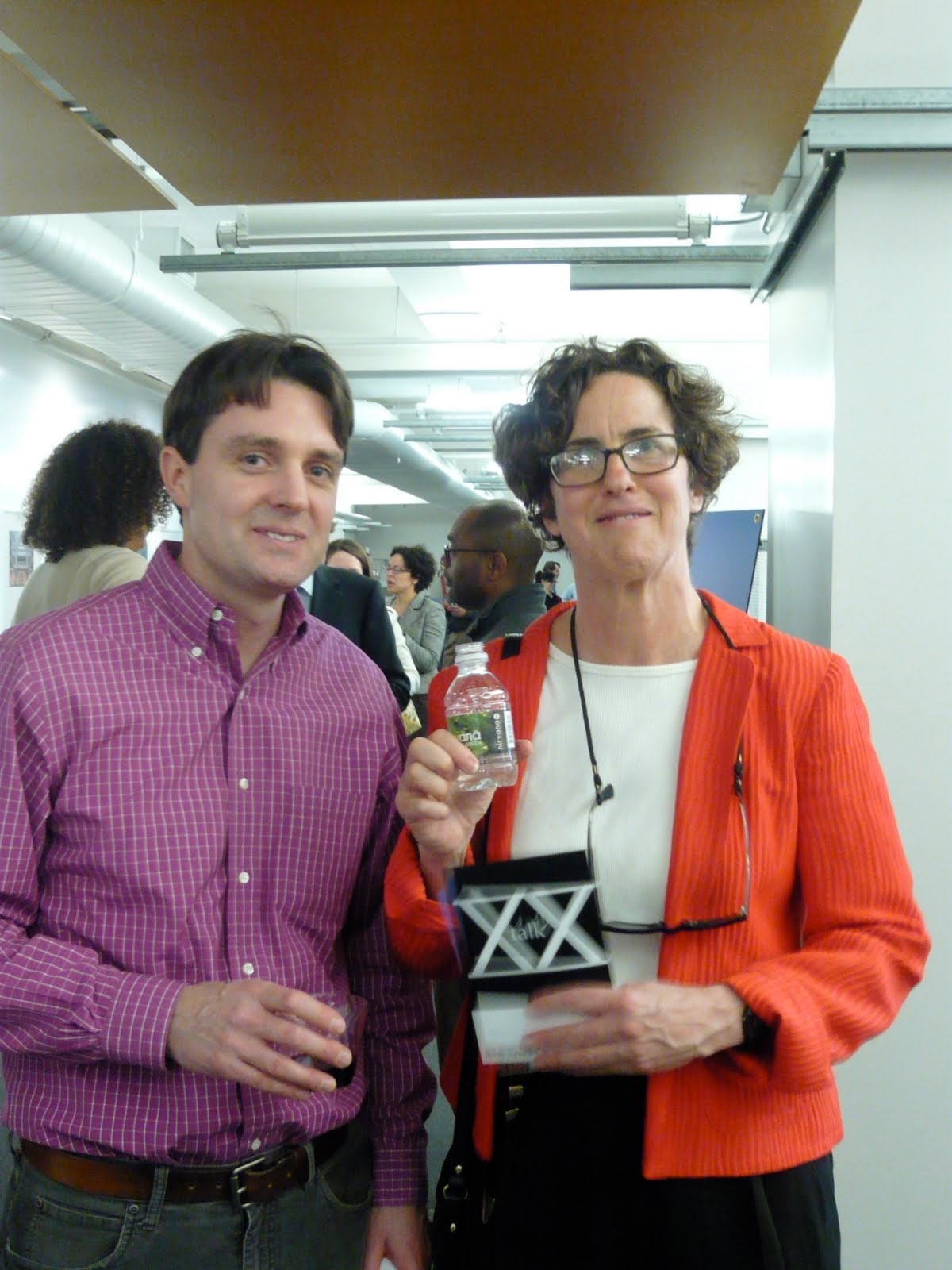
It is in one of the studios in a building run -- collectively organized -- by Caroline Woolard, a founder of Trade School (left):

I went to see Caroline in Bushwick on the L train, to see what the space was like, to have lunch and understand the business management side of their running the space.

It's a beautiful building, sturdy with good bones, industrial history, and quiet workaday elegance.

And, de rigueur, steep steps with a bicycle.

Everyone who takes a studio space has to find their own doors. The solutions are infinite and kind of captivating.


Our first stop was Caroline's space. She has incredible material resourcefulness, always building things she needs. A few of the many examples:

A filing system (those poles slide and the folders are fabric):

A storage platform (sections of the planks lift up like trap doors):

A different filing and storage system:

A hugely admire Caroline as someone with both a creative instinct and a tendency to simply do things. I would call her an Action Nerd. A thinker but a doer. She and friends managed to take on the commercial lease of the building and were figuring out real economic questions like how or whether to get paid -- against ethical standards of masterpiece proportion -- when they spend a lot of time, struggle to make ends meet, take on a lot of risk and responsibility, and still charge themselves rent.
We had this discussion over homemade quiche in the kitchen, then, having lost track of time, I had to take a car service clear across Brooklyn to meet Mark of the Egg at his Dumbo office.
The tour of the studio also included. . . the jumbly:

And the spare:

Interesting items, items everywhere. From the person who worked with nature:

To the studiomate who worked abstractly with electrical wiring:

To the body caster and sculptor:


To that art studio standard, the storage of goods/incidentals in a way that takes on a narrative quality:

World Cup Sunday, I took a group of Museum Legs interested people on a fieldtrip to the Whitney Museum. The genesis was an email from a guy I'd never met called Jonathan Ellis who read Museum Legs and got in touch. He is, incidentally, a top hire for any museum finance department needing new staff. If memory serves, he is in law school, has a finance background, and also an art history major. He's also a really nice guy. Amee, my good friend, then put me in touch with a colleague of hers, Frank, who is devoted to the arts and spends much of his spare time going to museums. We all -- plus Amee's husband Michael and visiting old friend -- set out to see the Charles Burchfield at the Whitney. Here's the group after lunch at the end:

And at the beginning. . .


I had wanted to see the Charles Burchfield, recommended by Mark of the Egg (whom I seem to keep mentioning but, in fairness, with whom I also have a regular ongoing conversation about museums on account of our work). Mark had seen the show where it originated at the Hammer in LA. What's most unusual about it is that the artist Robert Gober (of the wax leg sticking out of the wall in Museum Legs, The Insulated Judiciary chapter) curated it and wrote all the wall labels. Being an artist himself, he wrote the labels with fantastic restraint about explicating the work. Gober shows instead of telling. He lets the painter speak for himself, mostly by quoting Burchfield's diary. Burchfield was an honest scribe of really dark inner thoughts, which add immensely to looking at landscapes that are, in some cases, Liberace meets Bob Ross.
I am a fan of the work, sometimes for reasons I don't even understand myself. And the catalog was so good I almost bought one. Example: Dave Hickey saying Burchfield's work is the kind of thing best encountered by accident in someone's home, like in the hallway on the way to the second bedroom or the bathroom.
We also visited the Christian Marclay show, a more participatory affair in which a vast gallery wall had been covered in blackboard paint and lined with musical score. Whatever notes people added in, the artist would play. There was a man in the gallery who was packing up after a performance whom I could only glean was Christian Marclay. We spoke for a while and then our group adjourned for lunch at Via Quadronno, an experience of being in Italy on the Upper East Side.

After lunch, half the group went across the park to watch the World Cup Finals, something we wouldn't have missed for the Whitney. Art never trumps sport to that extent -- even for me -- and we had moved our museum date early to make that work. In the end, I watched the game in a restaurant that had stopped serving at 4. The entire staff of the kitchen, mostly Hispanic, had come out to watch. I had started the match cheering for the Dutch, but then when they started playing really dirty, it was pretty hard not to cheer for Spain. Especially with all the guys from the kitchen behind me. I got to share their happiness and pride when Spain won, and to ask them to translate when the Spanish player who scored the winning goal stripped off his shirt to reveal a vest with a written message. (It was a tribute to a teammate who had died of exertion suddenly the year before.)
From there, it was back from sport to art as I raced for the Staten Island Ferry to make it to an art opening. Here is the ferry captain's team allegiance on view (a picture I endured yelling to take since it meant stopping even for a split second in the middle of a throng of people advancing onto a boat as if a wave ourselves). It's that orange jersey behind the flagpole:

I never tire of this view:

The show was at the Alice Austen House, known to taxi drivers on Staten Island as "Alice House." It is celebrated as the home of Alice Austen who was a photographer, among other things, and more generally a polymathic Victorian woman who left the house and had a creative life.

Above is what the inside of the house looked like with the art up, below the outside:

More aptly, the originating aesthetic of the place, shown in the foyer:

The house overall:

And its flourishes in the details -- e.g., this birdhouse:

And vignettes:

There were vistas too. Many people there were professional photographers. There was a lot for the taking, with this kind of light, except I (and many others) didn't have the cameras on hand to capture it. You can imagine the shot you could have gotten with more zoom and an ability to foreground that red boat but still make it look at sea (and in front of a towering skyline).

And you can imagine the portraiture available here, with that kind of light on people's faces, again, given a better lens (or walking legs and sense of social adventure).

Indisputably, there was also Tonto the pug to appreciate, a lot easier to photograph.

And Michel and I played a long and hilarious game of badminton with two twenty-five year old actors recently relocated to New York City, with that kind of energy of youth and possibility and dreams. I think they had no idea our age. One of them in particular had such comedic body control that whenever he served he would make himself into the lithe yet formal caricature of a badminton player out of the 1920s, and it always made me laugh in a way I think was part of his competitive strategy.

Here Michel and Mike Ducklow (photographer), fellow Memphians, are on the ferry back. The badminton team:

And the very mundane yet wonderful view of people looking at the Statue of Liberty:

My next art outing was the Matisse opening with Veronica at MoMA. It was one of Veronica's last weeks at work, and the invitation came out of an offer on my part to help her pack up boxes. The show itself was surprisingly cool -- some Matisse paintings like a bowl of apples on a table that I had never seen. I also hadn't known Matisse was such a gifted traditional painter. MoMA, to its credit, had figured out how to xray the central painting of the show to create an animation of how it was painted, as if you were walking into Matisse's studio periodically over the life of the painting's creation.
At the reception, I got to be a fly on the wall as people told Veronica how much she would be missed. I was incredibly touched on her behalf, especially as some of the art handlers told her, rather matter-of-factly and without pretense, how much she had the respect of people in the institution who made art themselves, many of whom had worked there long enough to cut their teeth on the job alongside curatorial greats like Kirk Varnedoe. V with one well wisher:

And leaving through the garden as the party cleared the other direction:

V with colleagues in their offices:


Many books packed and carted down, we got through just before the doors were closed by a guard who looked too young to have worked there about twenty years.