Showing posts with label Philadelphia. Show all posts

Saturday, May 29, 2010

The Alsdorfs, the Cecil-Kirks, and Talk 20

Tom Kirk, my high school friend Grey's husband, kindly invited me to participate in a rather ingenious--though he said wholeheartedly copycat--program called Talk 20.  Periodically, his architecture firm, Bohlin, Cywinski, Jackson, invites eight or ten people to give talks in succession.  Each person gives 20 slides for 20 seconds each (6-7 minutes), so the whole program runs about an hour.  BCJ is known for many things, among them the Apple stores:
On the scheduled day in February, I took an early train to try to avoid a snowstorm, but once I got to Philadelphia the program was postponed for weather.  Grey had just had a second child, and her parents--my hosts in Birmingham on the book tour--were there too, so it turned into a big family visit.


Brigham, the architect who was organizing the program, could not have been nicer or more apologetic.  We rescheduled for the following month, and it all actually happened.


While killing time between the train and the talk, I sat in a coffee shop Brigham had recommended, where I couldn't help but try to recreate the Bar at the Folies Bergere painting:

Now I realize how different the painting actually looks:
25515.jpg

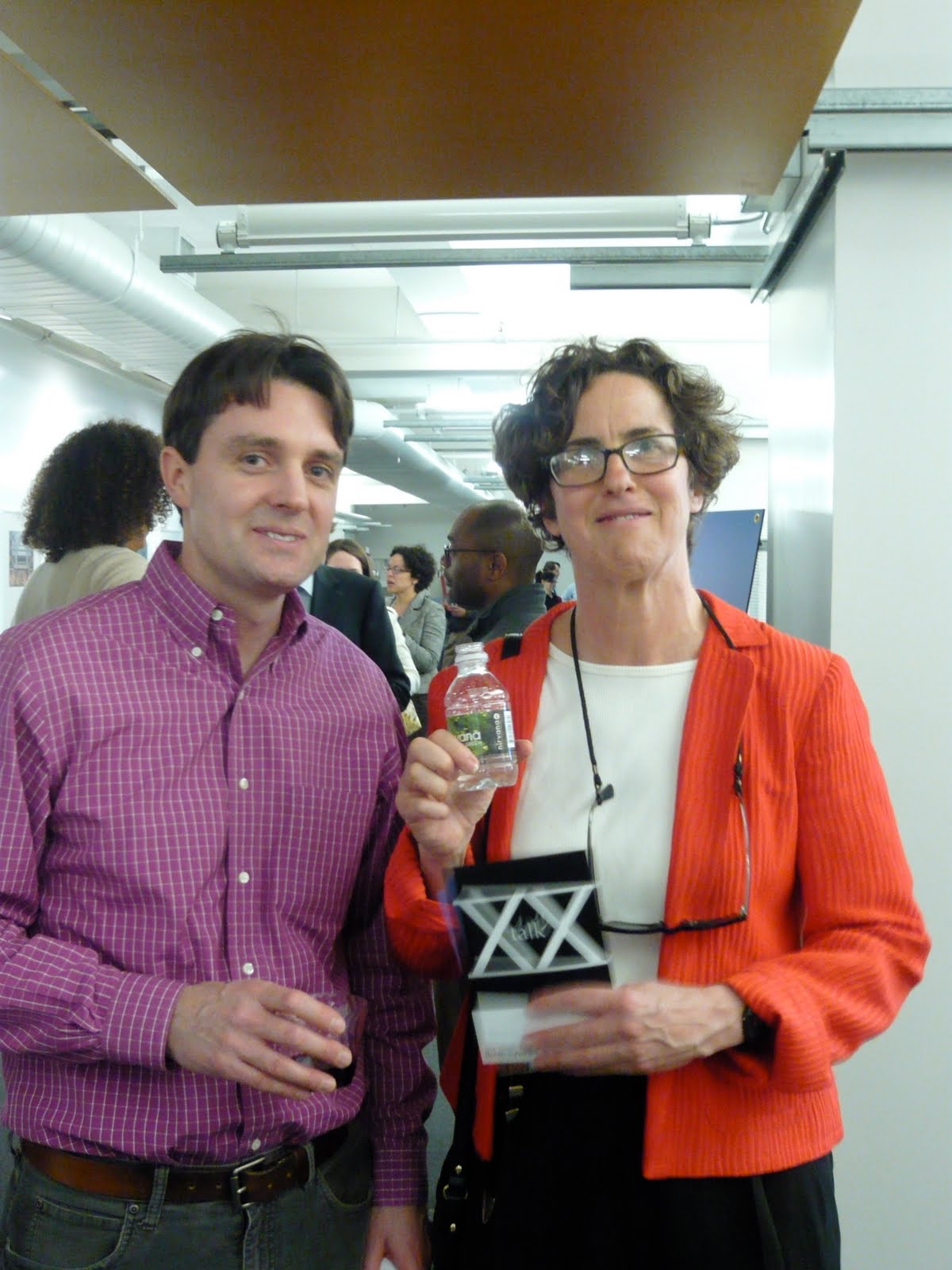
Arriving at the firm, I met up with Tom (pictured below) and Brigham, who showed me all the plans for the new Williams library.
The firm had a happy hour beforehand, at which I met this collaborator of Tom's:
She asked how we knew each other and we both paused -- me because I think in the workplace the person who actually works there should get to tell any personal stories -- and this caused her to tease Tom in an almost British way, seeking innuendo with missile clarity.  Here's a sense of the place, and the party:

(I'm pretty sure I own exactly this chair (a Modernica replica of an Aalto) but in red.)
We spent most of the time talking to my fellow presenter -- also a friend and invitee of Tom -- named Arika Okrent.  She wrote a book called In the Land of Invented Languages (that I am reading now and keep recommending to people).

BCJ was founded in Wilkes Barre, Pennsylvania which, by coincidence is also the hometown of my first art history professor from college who knows a couple of the partners.  I seem to thrive on this sort of small world connectedness.  In this picture, Brigham, who also MC'ed, is in the back left corner, with Bernie, the partner who gave an introduction and a synthesis at the end.
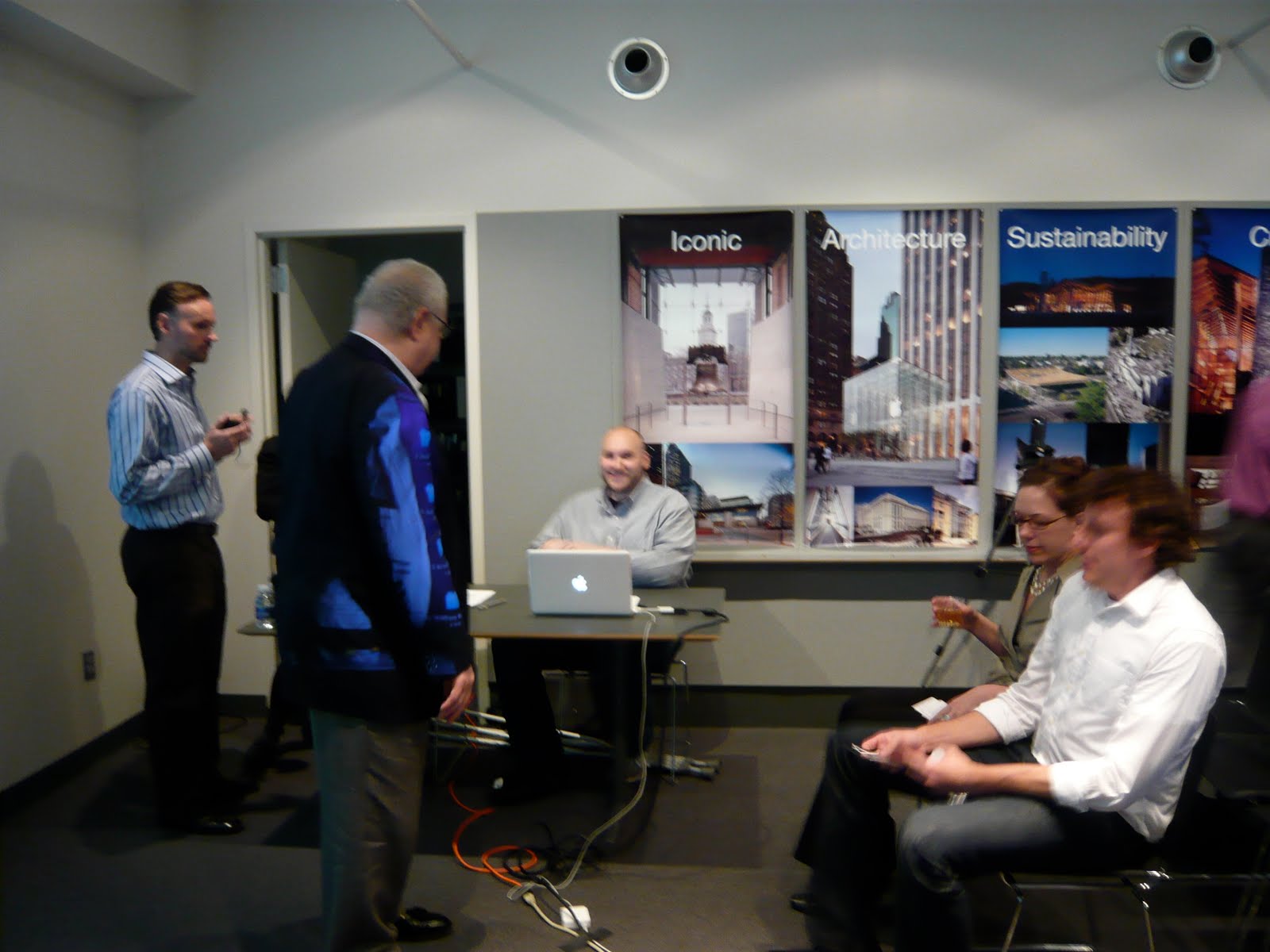
Here's how it all began.  They would tee up someone's powerpoint, look to the presenter, who'd call him or herself out of the starting blocks, and we would be off.  The slides were auto-timed to change over every twenty seconds, which can be surprisingly hard to judge precisely.  Most people seemed to have done what I had done, which was to have slides nearly entirely free of text.  Much easier to finesse the transitions of pictures.
As Bernie said to us speakers, "Once you are on the slope you can only get off at the bottom."  By the end, the biggest theme to me seemed to be about the limitations of invention and the pleasure of repair.

We were started off by an artist named Nora Chase who made abstracted works based on patterns in the human body.  They would be absolutely beautiful and fastidiously made, and then you would realize each square in the series was a different skin rash.

Arika summarized her book on invented languages as, "900 languages, 900 years, language wins."  This is, by the way, a cautionary tale for anyone who works at a company trying to create what is essentially a business language. She showed one slide of Charles Bliss, the founder of Bliss symbolics, a language of pictures meant to be universal.  It was, instead of being adopted by everyone, adopted by a facility for children with cerebral palsy, in Canada.  She talked about a feminist language with as many languages for menstruation as Eskimo words for snow (okay, they had six words).  She had fantastic photos of attending a Klingon conference.

The third guy was an extremely cerebral academic who was "reconciling poetics and ethics," and talking about a "science of imagination solutions."  My fravorite notion from it was (and this might come from Alfred Jarry-- I can't read my notes) in order to truly demolish something you have to demolish its ruins too.  You use the ruins to build beautiful new buildings.  

Also from my notes, "The best thing you can do for sustainable design is to make beautiful things people won’t want to tear down."  This may have come from the fourth speaker who talked about a building project in a remote Ecuadorian village, reachable by long bus ride, followed by three-hour canoe ride.

Jamie Montgomery, whose company is called FieldDesk, ended with a fantastic talk on repair. His charming refrain was, "Sometimes I feel mad, sometimes I feel lucky."  He would buy things that were broken that he knew he would need to repair (but he is lucky because he knows how to do it and therefore can buy nice things).  His motto might have been "Build well, well built."  And his goal was for everything he built to be "worthy of repair."  He spoke about the notion of wanting to make something right again.  "I want to feel my world is intelligible so I can respond to it."

He showed us how Tokyo phone poles are made for repair.  The bottom always rots out first and needs to be repaired.  There, the poles have joinery for the lower part to be detached and restored.  He showed us the men in his family's tendency to buy dilapidated log cabins (of the sort where you can hardly make out that it's a standing structure) and then to rebuild them.  He showed us how he re-shingled his roof.

Somehow, the combination of repair as a badge of honor, the impossibility of inventing a language from scratch, and the limitations of economic masterminding of art or museums all formed a hopeful vision of chaos, a deeply human imperfection, and an ability to right ships, to fix things, and to design them to stay around for a long time.  It's refreshing to think whistles and bells are only great when one needs an actual whistle or an actual bell, and that one wants the whistle or bell to be simple and well made.

Grey stayed home with the boys and we caught up the next day.  Here she is in their cheerful and beautiful kitchen with their littlest one.

And the family portrait:
In honor of the big brother, I create here a photo essay of his airplane collection.  These are for me to show to my brother, a lover and expert about planes, so he can help us ID the models:


The artist (aka big brother) at work:
On the way back, I was nearly dumbstruck by how calmly people queue for the train in Philadelphia.  Not in New York:
postscript: The Alsdorfs, Sarah and Bob, the tragically underdocumented (read: unphotographed) hosts of my book tour trip to Seattle, came to New York to visit their son Matt, my college friend.  We all went to the Whitney Biennial.  Judge Alsdorf (aka Bob) has a wonderful way of deadpanning titles to abstract sculptures that sound plausible, and are not at all true.  Here we are afterwards: 

Friday, November 13, 2009

September 16th and 17th - Philadelphia and Pottstown, PA


After the West Collection, I drove into Philadelphia to visit with Grey, my friend from high school with whom I was staying the night.  I was reading at Robin’s Books later in the evening, and spent the afternoon with Grey and her son Shuford.


Grey read the Museum Legs table of contents aloud, and every time she said a chapter title, Shuford would repeat it back like a cheer: “The Insulated Judiciary.”  Met by, “THE INSULATED JUDICIARY – YaaaaYYY!!!!!” 


There were three people at my first reading -- Grey, the bookstore owner, and a woman named Myna.  I was reading at Robin’s, the oldest independent bookstore in Philadelphia.  Unbeknownst to me, though, it had closed the year before.  It reopened as a non-profit performing arts space – on the second floor.  We were trying to go there and accidentally walked past. 

At some point, I had gotten a bit of advice from other writers who had been on book tour.  One friend, Michael, said, “It’s going to happen. You are going to have a reading where no one shows up.  Or one person, or two.  It’s just part of it.”  This piece of advice reminded me of receiving pointers from my sister’s quite athletic friend before running the New York Marathon.  I had said to her that I was making peace with the fact that I would, at some point, get passed by a guy in a bear suit.  Without missing a beat, she replied, “I got passed by a lobster.” 

The first reading was definitely a lobster moment.

Full credit to Grey for being attendee 001. Myna had an encyclopedic knowledge of local union relations with art-school teachers and said a photography opening scheduled at the same time had kept people from coming. Robin was really interesting and engaged, though I couldn’t help but feel bad. Parenthetically, Robin’s has a lively program of political and historical commentators coming to speak. And a high quality half-price books section.

The next morning, we harkened back to “art in the everyday environment” – as in the West Collection – when we took Grey’s son to the school run by Robin’s wife.  I liked the art enough both to get out my camera and to ask for permission to take photographs in a room full of four year olds (none of whom are photographed).  The mural is in the entry hall, 


the wings and hands in the crafts room. 


The stroller rack:


September 17 – The Hill, Pottstown, Pennsylvania

From Philadelphia, I drove out to Pottstown, Pennsylvania, to guest lecture in a high school art history class, thanks to an introduction from my sister’s friend Dana.  The Hill, a cloistered residential school, is one of those really special places that anyone who has attended loves and whose good will is palpable to anyone else upon arrival – even to strung-out people who almost forgot they had an appointment with Mrs. Nelson, the lovely art teacher.


Mrs. Nelson is one of those people who lavish attention on others.  She has such a kindly and enthusiastic temperament that when she told me she had taught there for 25 or 30 years, I thought she must have started when she was 12. Her husband teachers there too.  I had lunch with them and a group of students in an old, wooden, Harry-Potter-style dining hall where the whole school eats together. 


The walls are covered in NC Wyeth paintings.  These are extremely valuable, but rather than over-thinking their value and replacing them with copies (and occasional administrative thought), they let the students live with the originals and just don't advertise them (my apologies for doing that here).

I sat wit the Nelsons at one end of a long table full of students. Over lunch, they had school-wide announcements followed by a standard blessing that they say everyday. You could tell the grace was well rehearsed because exactly on the "Amen," the students got up with a Jeopardy-buzzer quickness to be first in line to serve their tables. Lunch was mystery Mexican wraps – as Ellen’s husband said, “I think pork.” At the end of the meal, they cleaned plates so quickly I felt solidly out of practice at eating in a high school.

Ellen and I walked over to the art building, full of interesting things like this mosaic of a unicorn tapestry. 


I chatted with her class about museum history and what some different career tracks were in museums.  The students were so good-natured, I was mostly reminding them that they can do whatever they want to do. You could sense how smart and nice everyone was, just good kids everywhere.


Afterward, Ellen and I toured an art exhibition she had helped to organize, with beautiful colors and surfaces of paintings. 


Then we visited the library (more original art, probably highly valuable, still lived with). As Ellen walked me to my car she gave me a wrapped present that was a Hill mug.  I gave it pride of place in the ‘crazy person’ pile of things in the car (better to look crazy and disorganized than like you have valuables), and I drove south to Charlottesville.

Wednesday, November 11, 2009

September 16th - The West Collection


Museum Legs is a populist book.  So it makes sense that the first stop on the tour was about art in its most everyday environment: the workplace.  I was going to see the West Collection, the art collection of SEI Investments, about twenty miles outside of Philadelphia.   It is one of the most heartening things I have ever seen, a great example of complicated, toothy art that is not "difficult" in a prickly way so much as simply compelling and interesting.


Arriving late the night before, even in the darkness, with droves of deer at the side of the road, you could feel the spaciousness of the landscape -- quiet, rolling dark hills, calm and dignified, already far from New York.  


SEI is a financial services firm -- in the back office of asset management, making things happen sense -- that was incredibly technologically inventive when it was founded in the 1960s by Alfred P. West.  It is also the kind of place where you might work next to a three-foot-tall pair of wingtips made entirely out of licorice.


Paige West, daughter of the founder, spearheaded an art collection now directed by Lee Stoetzel, himself a practicing artist.  I was there to meet Lee who had kindly offered to take me around, on introduction from Sunny Bates, patron saint of the Museum Legs book tour.


You drive up to SEI corporate campus, a cascading series of large, artful, corrugated metal buildings, most a deep slate green with bright red trim, marked by a simple sign and not near much else.  


The visitor's lobby


is a clue of what is to come with a wall full of Roxy Paine fiberglass poisonous mushrooms (same artist of the beautiful aluminum modernist swamp tree on the roof of the Met), 


a candle-dipped saw, 


and a massive spherical light fixture covered with flittering loops that looked like insect wings crossed with rose petals.  The tables are covered with neat arrangements of The Wall Street Journal or the FT, and an array of business monthlies.  Lee came out to me and we walked through heavy doors into the offices proper.  The first sight was a row of landscape paintings, in bright, stylized colors, immediately adjacent to the large LED screens showing the stock market stats for exchanges around the world.


The interior of the building is almost entirely open plan, a vast room with many windows onto the uninterrupted landscape outside.  Large clusters of coiled cables -- they call them pythons -- fall from the ceilings at intervals, chunky bunches of black and red cords that stretch down to various desktops at different angles.  All the desks are on wheels.  People can move their desks to sit where they want.  There is art everywhere.  Groups of people can chose the art that will be near their desks.  Lee and co. curate the art in the common spaces.  


Chairs next to a towering sculpture made out of Fiestaware dishes.


A second collection of Roxy Paine mushrooms 


sits near a life-size Humvee that is sewn out of fabric, long strings dangling.  


Outside the auditorium, you come across a workman's set up of ladders, wood, and power tools -- 


except that the entire thing is carved out of wood, including the tangled cords of the power saw.


Lee explained the principles for collecting: They can only buy first-rate work.  They cannot, with rare exception, spend more than $5,000 on any one piece.  If they cannot get a first-rate work for that price, they decide that they have missed the window for that artist.


When works come into the collection, anything that may be controversial is shown in the downstairs hallway called the "Hot Hall."  Near the artworks there are computer terminals where people can anonymously comment on the work.  


Lee and team then print some of the comments and post them on the wall near the work.  


There is a series of photographs in the hall upstairs of primates who are specially trained Hollywood acting animals.  The artist hires them, pays them a day rate, and then gets them to make certain very human expressions.  They look uncannily like people, except with odd physical features, as if a person whose head slopes immediately backwards from the top of the forehead, or with eyes very close together.  Their pathos is otherwise eery.  


The same artist had two works in the Hot Hall in which instead of hiring highly trained animals she hires child actors.  The children are paid their day rate and come with their parents.  The artist is really nice to the children and gives them lollipops.  Then on a cue, the parents snatch the candy away and she takes their picture.  The result are huge, up-close, probably five-by-seven-foot images of photogenic children absolutely bawling.  


One comment next to them basically said, "I have to look at crying children all the time at home.  It is unfair to make me look at them at work too."


If your interest is (as mine is) in making art more accessible to people, seeing art in museums has huge limitations in comparison to living around art in the workplace.  These people see work day in and day out.  And it is not just small poster-size work hung by the elevator so you can tell which floor you got off on (see later post on Microsoft's art collection).  It is big and it simply sits there.  


(if you look a the top, you can see that it is carved out of the sides of phone books)


(not digitally altered, these are the actual colors -- I just liked this one.  Below, with power drill)


In 20001, Forbes said of SEI, "based in Oaks, Pa., has a five-year average growth rate of 37.7%--more than double the 17.8% average growth rate of the companies surveyed by Forbes.com."


Here is a picture of Lee Stoetzel's own art.